
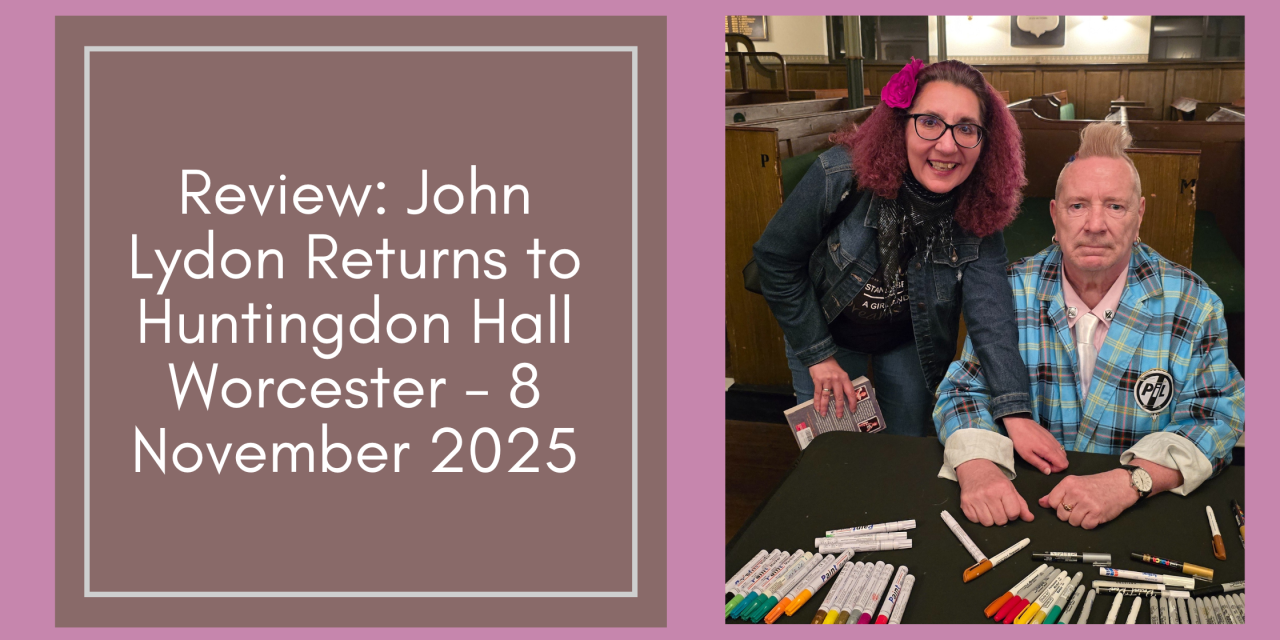
When I learned that John Lydon was returning to Huntingdon Hall in Worcester for another leg of his “I Could Be Wrong, I Could Be Right” spoken word tour, I didn’t hesitate to book my ticket. Having been to his show at the same venue back in May 2024, I knew exactly what to expect. And yet, nothing could have fully prepared me for how much more profound this experience would be, eighteen months on from the loss of his wife Nora.
The moment I saw the tour dates announced, I was online booking. Call it obsession, call it dedication, call it whatever you like – but when John Lydon comes to your city and you have the chance to see him again, you don’t pass it up. I’ve been a fan of the Sex Pistols, Public Image Limited and John Lydon from as far back as I can remember, and there’s something about John’s uncompromising authenticity that has always resonated with me on a deeply personal level.
Meeting the Man Behind the Myth
Once again, I splashed out for the meet and greet package. If you’re going to do something, do it properly, right? And honestly, after the profound experience I’d had meeting John the first time, I knew I wanted that opportunity again. Meeting your heroes can be a gamble; sometimes they’re nothing like you imagined, sometimes they’re worse, and very occasionally, they’re everything you hoped for and more.
John Lydon falls firmly into that last category.
There’s something genuinely disarming about meeting someone who has spent decades being unapologetically themselves. No pretence, no bullshit; just John, as raw and authentic as he’s always been. The meet and greet wasn’t some rushed conveyor belt affair where you get thirty seconds and a forced smile. John actually engaged with each person, looked them in the eye, had real conversations.
We chatted briefly about the tour, about loss, about carrying on when everything feels impossible. Having lost people close to me and having navigated my own trauma over the years, there was an unspoken understanding between us. He signed my copy of his autobiography for me, and when I told him how his openness about grief and trauma had resonated with me so much, he simply nodded and said, “We keep going, don’t we?”
That’s John in a nutshell. No flowery words, no platitudes, just the raw truth. We keep going.
The Show Begins: Familiar Territory, New Depths
The show itself felt both familiar and entirely new. If you were at the May 2024 show like I was, you’ll know that John’s spoken word performances aren’t your typical celebrity Q&A. This isn’t some sanitised, corporate-friendly trot through career highlights where every answer has been rehearsed and every anecdote polished to perfection. This is John Lydon unplugged, unfiltered, and unflinching.
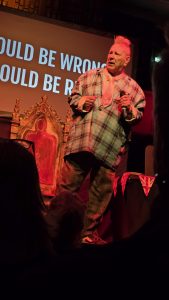
He walked onto that stage at Huntingdon Hall – the same stage he’d graced eighteen months earlier – with his trademark swagger, albeit one tempered by the weight of everything he’s been through. He’s there with his bottle of Corona (yes, we’re still paying for it, as he gleefully reminded us), his well-timed belches into his microphone that somehow manage to be both juvenile and endearing, and that glorious C-word that punctuates his stories like a verbal exclamation mark. “You f**kers paid for this!” he announced, gesturing at his beer, and the entire room erupted in laughter. This was going to be exactly what we came for.
But what struck me most this time around was the evolution in his delivery. Eighteen months ago, the grief was still so raw, so present. The loss of Nora, his wife of 45 years and Rambo, his best friend and the man who conceived this very tour, hung heavy in the air throughout that first show. The pain was palpable, the wounds still bleeding. It was beautiful and heartbreaking in equal measure.
Grief, Growth, and the Road Forward
This time, while the pain is still there ,and John makes no attempt to hide it or minimise it (the tears welled up when he talked about his beloved Nora) there’s something else too. A kind of hard-won acceptance, perhaps. Or maybe just the sheer bloody-minded determination to keep going that has defined his entire career. The grief hasn’t gone anywhere; it’s just become part of him now, woven into the fabric of who he is.
He spoke again about how this tour was Rambo’s concept, how it became his therapy, his way of processing everything. But this time, he talked about it with a sense of purpose rather than pure survival. “Rambo would’ve wanted me to keep going,” he said, “not because he’d want me suffering, but because he knew this was important. And he was right, the bastard.”
“I could be wrong, I could be right,”is the opening line from PIL’s song “Rise”, taking on deeper meaning with each telling. It’s a mantra for grief, really. For continuing when you don’t have all the answers. For being human and fallible and doing your best anyway. For accepting that life doesn’t come with an instruction manual, and sometimes you just have to trust your gut and hope for the best.
The Stories That Shape Us
The audience, a mix of old punks with faded tattoos and studded jackets, younger fans who discovered John through their parents’ record collections, and curious locals who’d heard about this legendary figure, hung on every word. The demographic was wonderfully varied, but the audience was of, shall we say, an older vintage.
When John talked about growing up in post-war London, about the poverty and the violence and the struggle to be heard, you could hear a pin drop. He painted vivid pictures of a childhood that would break most people, and talked about the feeling of being invisible in a society that didn’t want to acknowledge your existence. He spoke about the meningitis that nearly killed him as a child, left him in a coma for months, and how emerging from that experience fundamentally changed him. “I came out different,” he said. “More angry. More determined. Less willing to take anyone’s shit.”
When he recounted the chaos of the Sex Pistols years, the Bill Grundy interview that shocked the nation, the furore around “God Save The Queen,” the constant battles with Malcolm McLaren, the violence at gigs, the room erupted with laughter and knowing nods. These are the stories of punk rock legend, but John tells them not as mythology but as lived experience. The good, the bad, the ugly, and the absolutely insane. He also touched on what for him is a very touchy subject – no pun intended – the BBC, and how they supported Jimmy Saville but tried to shut him down and cancel him when he called out Jimmy Saville as a child molester. He talked about this while showing a black and white photo of Jimmy Saville, and seeing the image made me feel sick. John called out the evil monster, was shut down and cancelled for it, and was proved right when Saville’s crimes came out many years later. It just doesn’t bear thinking about that Saville was supported by the BBC and given a free rein to do what he did. Absolutely abhorrent.
And when he spoke about Nora, about the 45 years they had together, about watching someone you love slip away slowly and being powerless to stop it – well, there wasn’t a dry eye in the house. “She was my anchor,” he said simply. “Everything I did, everything I achieved, it was because she was there. Not behind me, not in front of me – beside me. Always beside me.”
As someone who has experienced significant loss and trauma in my own life, I found myself nodding along, tears streaming down my face. This is the power of John Lydon’s honesty; he gives you permission to feel, to grieve, to be vulnerable. In a culture that often tells us to “stay strong” and “move on,” here’s someone saying it’s okay to fall apart, as long as you eventually pick yourself back up.
The Marmite Effect: Love Him or Hate Him
What I love about John, and what makes him like Marmite, as I said in my previous review is that he refuses to be anything other than himself. In an age of carefully curated personal brands and PR-polished personas, where every celebrity has a team of handlers telling them what to say and how to say it, here’s someone who will look you dead in the eye and tell you exactly what he thinks.
He doesn’t want your sympathy. He wants your engagement. He wants you to think, to question, to rage against whatever needs raging against in your own life. “Don’t agree with me,” he said at one point. “Think for your f**king selves. That’s the whole point.”
Some people find this abrasive. They find him rude, crude, difficult. And he is all those things. But he’s also deeply intelligent, surprisingly philosophical, and fundamentally honest in a way that’s increasingly rare. I’d rather spend an evening with someone who’s genuinely themselves – warts and all – than with a hundred polished performers telling me what they think I want to hear.
The Q&A: Expect the Unexpected
The Q&A portion was brilliant, as always. This is where John really shines, because you never know what’s going to come up or how he’s going to respond. John fielded questions about everything from the Sex Pistols reunion that will never happen (“Why would I want to go backwards? I’ve spent my whole life moving forwards, you idiots!”) to his thoughts on modern music, politics, and why butter really is better than margarine (trust me, he has Opinions with a capital O about margarine, and they are both hilarious and oddly compelling).
Someone asked him about cancel culture and he launched into a passionate defence of free speech that was simultaneously hilarious and profound, especially after he had talked so openly about his experience of cancel culture with the BBC. “You can’t cancel the truth,” he said. “You can try to shut people up, you can try to make them scared to speak, but the truth always finds a way out. Always has, always will.”
Another audience member asked about his creative process, and John gave a fascinating insight into how trauma and pain fuel his art. “I don’t sit down and think ‘I’m going to write a song about this,'” he explained. “It just comes out. It has to come out. If I kept all that shit inside, I’d explode. Or implode. One of the two.”
A younger fan asked for advice on dealing with anxiety and feeling like you don’t fit in, and John’s response was genuinely moving. He talked about being neurodivergent before anyone had a word for it, about feeling fundamentally different from everyone around you, about the isolation and the anger that comes with that. “Use it,” he told them. “Don’t try to be like everyone else. The world has enough sheep. Be a wolf. Be a lion. Be whatever the f**k you want to be, but be yourself.”
As someone who is openly neurodivergent myself – diagnosed with autism, ADHD, dyspraxia, and dyscalculia – this resonated deeply. The world needs more people telling young people it’s okay to be different, it’s okay to struggle, it’s okay to not have it all figured out.
Why These Shows Matter
As I left Huntingdon Hall that night, walking out into the crisp November Worcester evening, I found myself reflecting on why these shows matter so much. It’s not just nostalgia, though there’s certainly an element of that. It’s not just about being a fan, though I undoubtedly am. It’s something deeper.
It’s about witnessing someone who has lived through extraordinary things – the Sex Pistols revolution that changed music forever, decades at the forefront of culture and counterculture, personal tragedy and triumph – and who is still here, still fighting, still refusing to be diminished. Still getting up on stage and telling his truth, consequences be damned.
John Lydon’s spoken word tour is therapy for him, yes. He’s said as much repeatedly. But it’s also therapy for those of us who need reminding that it’s okay to be angry, to grieve, to rage against the dying of the light. It’s permission to be imperfect, to be “wrong” sometimes, to keep going even when we don’t have all the answers.
In my work in cyber security, I talk a lot about authenticity and transparency. About being honest about vulnerabilities, about not pretending to be something you’re not. John Lydon is the embodiment of that principle. He’s been showing us for nearly 50 years what it looks like to be authentically, unapologetically yourself, no matter what the cost.
Final Thoughts
If you get a chance to catch this tour at one of the remaining dates, do it. Don’t hesitate, don’t overthink it, just book the tickets. And if you can afford it, get the meet and greet. Because meeting your heroes is supposed to be disappointing, but sometimes – just sometimes – they turn out to be exactly who you hoped they’d be.
John Lydon is 69 years old. He’s been through more in one lifetime than most people could handle in several. He’s lost the love of his life, his best friend, and countless others along the way. He’s been vilified, celebrated, misunderstood, and immortalised. And yet here he is, still touring, still sharing his story, still refusing to go quietly into that good night.
I could be wrong. I could be right. But I’m bloody glad I went. And I’ve already booked my ticket including the meet and greet element for when he comes back to Worcester next year on 28 November. I have a front row seat as I’ve booked it so early, and I’ll have a bottle of Corona in my hand raised to John in solidarity.
See you on 28 November 2026 John. Keep going. We need people like you, now more than ever. I love you!








 Cyber Geek Girl