


Yesterday, on 24 March 2026, the Competition and Markets Authority (CMA) published the final report of its market investigation into veterinary services for household pets in the UK. It has been billed as the most extensive review of veterinary services in a generation, and for millions of pet owners across the country who have been struggling with escalating vet bills, it has been a long time coming.
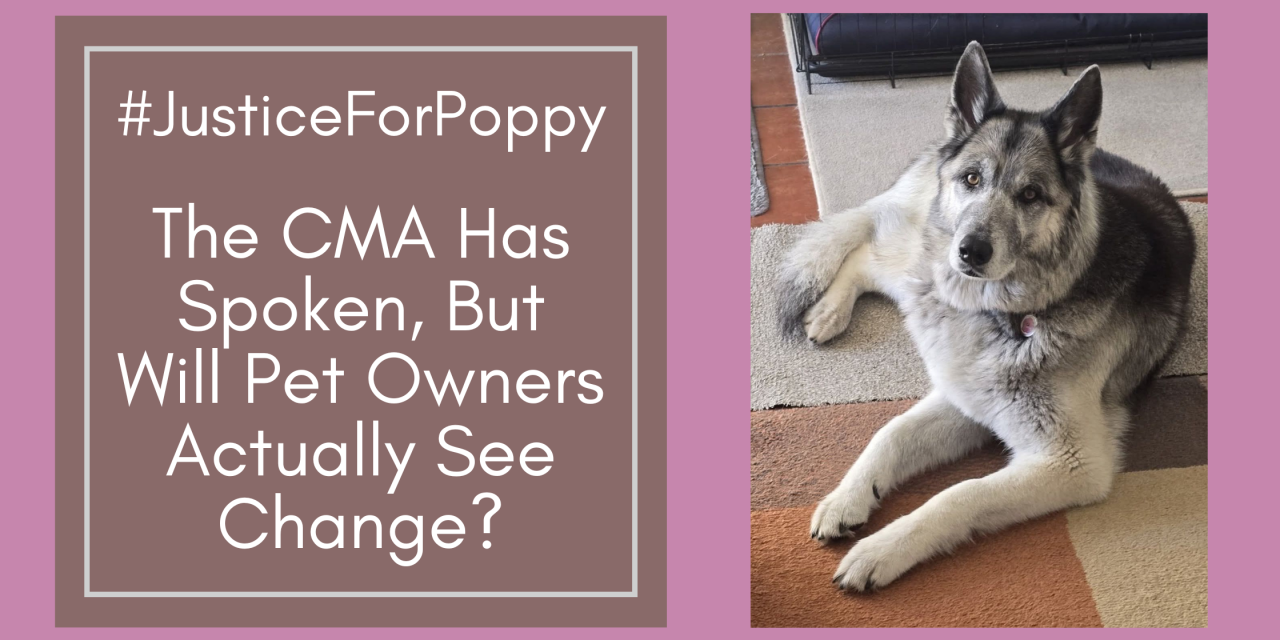
For those of you who have been following my blog, you will know that this is an issue that is deeply personal to me. In July 2024, my beloved dog Poppy became ill and had to be taken to Vets Now Worcester, the only out of hours emergency vet in my area. What followed was an experience that left me shocked, distressed and out of pocket, and it prompted me to write a series of blogs that resonated with thousands of you. My blog Greed Over Need: The Corporate Influence on Veterinary Services detailed what happened to Poppy, followed by Getting a Ruff Deal: The Extortionate Cost of Veterinary Care in the UK Laid Bare, and Response to #JusticeForPoppy: A Snapshot of the Extent of Extortionate Vet Costs in the UK, where I shared the many messages and emails I received from fellow pet owners who had been through similar ordeals. I also published the formal response I received from Vets Now to my complaint about Poppy’s treatment.
When I started my #JusticeForPoppy campaign, I said that one way or another I would raise awareness of extortionate vet costs and the lack of competition in areas like mine. The CMA investigation, which received an unprecedented 56,000 responses including 45,000 from the general public, has now concluded. So, has justice been served? Let me give you my honest take.
What the CMA Found
The CMA’s independent inquiry group found that the current system is, to put it plainly, leaving pet owners in the dark. A lack of information that helps people make informed decisions is leading to weak competition and high prices. This will not come as a surprise to anyone who has experienced the vet billing system first hand. When I took Poppy to Vets Now Worcester, the consultation fee alone was £320 just to walk through the door, before any treatment had even been discussed. Less than half of people using a large veterinary group even knew their practice was part of a chain, and less than half received pricing information in advance of non-routine treatment. Only 29% of those who did receive pricing information were given it in writing.
The CMA has introduced a package of legally binding remedies that will start coming into force later this year, with most in place within three to twelve months of the orders being made. These include requirements for practices to publish comprehensive price lists for standard services, provide written estimates in advance for any treatment expected to cost £500 or more, make ownership structures clear so pet owners know whether they are using an independent practice or one that is part of a larger corporate group, and cap written prescription fees at £21 for the first medicine and £12.50 for any additional medicines. A price comparison service will also be run through the Royal College of Veterinary Surgeons (RCVS) “Find a Vet” tool, and practices will be required to have transparent in-house complaints processes.
Martin Coleman, Chair of the independent Inquiry Group, said the reforms would make it clear to pet owners which practices are part of large groups and which are charging higher prices, and that for the first time, vet businesses will be held to account by an independent regulator.
My Response: Welcome Steps, But I Have Real Concerns
Let me be absolutely clear about one thing before I go any further. The problems in this market are not the fault of veterinary professionals. The vets and vet nurses who work on the frontline are not the ones pet owners should be directing their anger towards. I have said this consistently since I first started writing about this issue, and the CMA’s final report confirms it. The fault lies with the workings of the market and, in several cases, the practices and incentives of the management of some of the larger veterinary chains. Our vets at The Stocks Veterinary Centre in Worcester, and particularly Zoe Hart who looks after Poppy, are absolutely exemplary in their care, compassion and dedication.
That said, whilst I welcome the transparency measures, and the prescription fee cap in particular, I share the concerns of competition law experts Dr David Reader of the University of Glasgow and Dr Scott Summers of the University of East Anglia. Dr Reader reached out to me after reading my first blog on LinkedIn in July 2024, and together with Dr Summers, they have published extensive analysis of the CMA’s findings.
Transparency Alone Will Not Bring Down Prices
My biggest concern is this: there is no guarantee that these transparency remedies will actually bring down prices, nor prevent them from continuing to rise. Dr Summers has warned that empowering consumers is only half the challenge, and that there is no guarantee greater price transparency for procedures and services will stimulate meaningful improvements to price competition or lead to lower prices.
This is a crucial point. The CMA’s own investigation found that when choosing a first opinion practice, consumers are not typically guided by price, and they are not particularly interested in seeking out pricing information regardless of how easy it is to find. There is also a low propensity for consumers to switch between providers, even when they know there are potential cost savings elsewhere. As Dr Summers points out, save for medicines, there is no mention of remedies that would actually incentivise consumers to switch providers.
Dr Reader puts it in terms that many pet owners will recognise. He explains that this boils down to the difference between transparency remedies that actually help reduce average vet bills, which is what many pet owners are now expecting following the release of the final report, or those that merely remove the surprise element of a high vet bill. He notes there is a lingering sense that the transparency remedies, so often a starting point for addressing market failures, are also the end point in this investigation. His fear is a scenario where the remedy becomes, as he puts it, “transparency for transparency’s sake.”
I share that fear. When I received my bill of £556.68 from Vets Now Worcester, with £320 of that being a consultation fee just to walk through the door, knowing the price in advance would not have made it any more affordable. It would simply have meant I knew how much the shock was going to cost me before it hit. When your dog is ill and the only emergency vet in your area is a corporate out of hours service, you do not have the luxury of shopping around. I am also very lucky in that I have insurance for Poppy through More Than and was able to claim most of the cost back bar the excess. But many don’t have insurance, and don’t have that luxury.
The Risk of Further Corporate Consolidation
The CMA found that pet owners pay on average 16.6% more at large veterinary groups compared to independents, and that mergers and acquisition activity by at least three of the large veterinary groups has resulted in a 9% increase in average prices. Yet the report concludes that local market concentration is not widespread enough to have contributed to price increases at large. I find this difficult to reconcile with the lived experience of pet owners like me, who have no choice when it comes to out of hours emergency care.
Dr Reader has raised serious concerns about the CMA’s ability to keep further consolidation in check. He warns that the risk of further corporate consolidation is real, and that the CMA’s main instrument for reviewing vet mergers has been significantly blunted during this investigation. The government has put pressure on the CMA to narrow its “share of supply” test, which was the tool the CMA relied upon in all previous merger interventions in this market. Dr Reader and Dr Summers expect a further decline in the number of independent veterinary practices following the implementation of these remedies, despite a recent surge in new independents during the investigation period.
This is deeply worrying. When I wrote about the lack of competition for emergency vet services in Worcester, I highlighted that Vets Now was the only option available to us. If independent practices continue to be squeezed out, areas like mine will become veterinary deserts where pet owners have no meaningful choice at all. Reader and Summers argue that the CMA adopts an overly simplistic approach to analysing local concentration, which ultimately understates the power of large groups in particular regions.
The Shadow of the Government’s Growth Agenda
Another significant concern raised by Dr Reader and Dr Summers is the impact of the current government’s pro-growth strategic steer on the scope and ambition of these remedies. Some of the reforms require legislative change, and there may be limited or no political appetite for them under Labour’s growth agenda. Key reforms on accountability, regulatory oversight, and complaints and redress have been left to the government’s update of the Veterinary Surgeons Act 1966, a piece of legislation that is now 60 years old.
Dr Reader warns that structural remedies were rendered impossible the moment the government issued its strategic steer. He notes that no Inquiry Group member would propose breaking up local concentrations when the pressure is on the CMA to clear the road for investment. He and Dr Summers have a great deal of sympathy for a CMA investigation team that has had to endure tremendous politically driven upheaval and moving of the goal posts at critical junctures during this inquiry.
I have to say I share their sympathy for the investigation team. This inquiry received an unprecedented public response, and there are clearly talented people within the CMA who have worked incredibly hard on it. But the political context cannot be ignored. If the remedies that require legislation never see the light of day, we will have a situation where the CMA has identified serious problems in this market, but the most meaningful solutions have been kicked into a different street entirely.
Prescription Fee Caps and the Medicines Question
The CMA found that over 70% of pet owners purchase long term medication from their vet practice, even though many could save £200 or more a year by buying online. The prescription fee cap of £21 for the first medicine is a welcome step. I know from my own experience with Poppy’s EPI medication just how much the costs add up when you have a pet with a long-term condition. The fact that some practices were charging £30 or more for a single written prescription was outrageous.
However, Dr Summers cautions that there are legitimate concerns about how the prescription cap will impact consultation and service fees that have historically been subsidised by higher markups on medicines. Medicine accounts for roughly 20% of first opinion practice revenues, and he suggests that savings on the average bill from this measure alone may therefore be limited. There is also a concern raised by Dr Reader that an important income stream for independent providers could, to a certain extent, end up being redirected towards large veterinary groups that operate in the online vet medicines space. That would be, as he puts it, a frankly absurd outcome.
Complaints and Redress: Progress, But at Whose Mercy?
The requirement for practices to have transparent, accessible in-house complaints processes and to engage in mediation where disputes cannot be resolved is another positive step. When I put in my complaint about Poppy’s treatment at Vets Now Worcester, it took weeks of chasing the wrong email addresses before I even got a response. The system was, to put it mildly, not fit for purpose.
But the CMA’s recommendation that the government establish a comprehensive system for complaints handling and redress is just that: a recommendation. It requires legislative change to implement properly. Dr Reader and Dr Summers point out that this remedy is at the mercy of a government that is taking steps to curtail redress schemes and private actions that risk deterring investment. By deferring this to the government, the CMA may have demonstrated a serious desire for an overhaul, but it also means that the decision on whether pet owners actually get effective redress now sits with politicians, not the regulator.
What This Means for Pet Owners Like You and Me
In practical terms, if your vet practice is part of a larger chain, you can expect to see changes before Christmas this year. Standard price lists, ownership transparency, written estimates for treatments over £500, itemised bills, and capped prescription fees will all be in place within months. Smaller practices will have a little longer to implement the changes. The RCVS will take a central role in monitoring compliance, funded by a levy on veterinary businesses.
These are meaningful and welcome steps forward. But let us be honest about what they are and what they are not. They are transparency measures. They will make it easier for you to see what you are paying, who owns your practice, and where you might be able to save on prescriptions. What they are unlikely to do, based on the expert analysis of Dr Reader and Dr Summers, is meaningfully reduce the overall cost of veterinary care, particularly for those of us who have limited choice in our area.
Has #JusticeForPoppy Been Served?
Partially. The CMA has shone a much-needed spotlight on an industry that has been operating in the shadows for too long. The fact that 56,000 people responded to this investigation tells you everything you need to know about how strongly people feel about this issue. The transparency measures are a good starting point, and the prescription fee cap will make a tangible difference for many pet owners.
But a starting point is exactly what this should be, not the end point. As Dr Reader and Dr Summers have argued, there is a risk that these transparency remedies become transparency for transparency’s sake. The real test will be whether prices actually come down, whether corporate consolidation is genuinely kept in check, and whether the legislative reforms that underpin the most important remedies ever see the light of day.
I will continue to follow this closely. I owe it to my beloved Poppy, and to every pet owner who reached out to me after my blogs to share their own stories of extortionate bills, corporate greed and a system that too often puts profit before the welfare of our animals. The CMA has acknowledged the link between access to affordable care and animal welfare. Now it is up to the government, the regulator, and the industry itself to ensure that acknowledgement translates into real, lasting change.
I said it in July 2024, and I will say it again: one way or another, I will get #JusticeForPoppy.
References and Further Reading
CMA concludes market investigation with major reforms to veterinary sector, GOV.UK, 24 March 2026: https://www.gov.uk/government/news/cma-concludes-market-investigation-with-major-reforms-to-veterinary-sector
Dr David Reader (University of Glasgow) and Dr Scott Summers (University of East Anglia)
Reader_&_Summers_(2026-March)_Initial_Reaction_to_VetMI_Final_Report_FINAL
Dr David Reader (University of Glasgow) and Dr Scott Summers (University of East Anglia)
Press response – CMA Final Report (Summers and Reader)
Lisa Ventura MBE, Greed Over Need: The Corporate Influence on Veterinary Services, Cyber Geek Girl, 8 July 2024: https://cybergeekgirl.co.uk/new-blog-and-review-greed-over-need-the-corporate-influence-on-veterinary-services/
Lisa Ventura MBE, Getting a Ruff Deal: The Extortionate Cost of Veterinary Care in the UK Laid Bare, Cyber Geek Girl, 13 July 2024: https://cybergeekgirl.co.uk/getting-a-ruff-deal-the-extortionate-cost-of-veterinary-care-in-the-uk-laid-bare/
Lisa Ventura MBE, Response to #JusticeForPoppy: A Snapshot of the Extent of Extortionate Vet Costs in the UK, Cyber Geek Girl, 28 July 2024: https://cybergeekgirl.co.uk/response-to-justiceforpoppy-a-snapshot-of-the-extent-of-extortionate-vet-costs-in-the-uk/








 Cyber Geek Girl